
On one hand, it’s still the same human thing. You walk in (or log on), try to connect, try not to ramble, try to prove you can do the job without sounding like you swallowed a corporate handbook. 10 Expert Interview Tips to Get Hired Faster
On the other hand, hiring is faster, noisier, and more automated than ever. Recruiters are juggling more applicants. Teams are lean. And you’re often being evaluated across multiple layers, including structured scorecards, work samples, and yes, sometimes AI assisted screening notes.
So if you want to get hired faster, you need two things at the same time:
- A clean, confident story.
- Evidence. Specific proof you can execute.
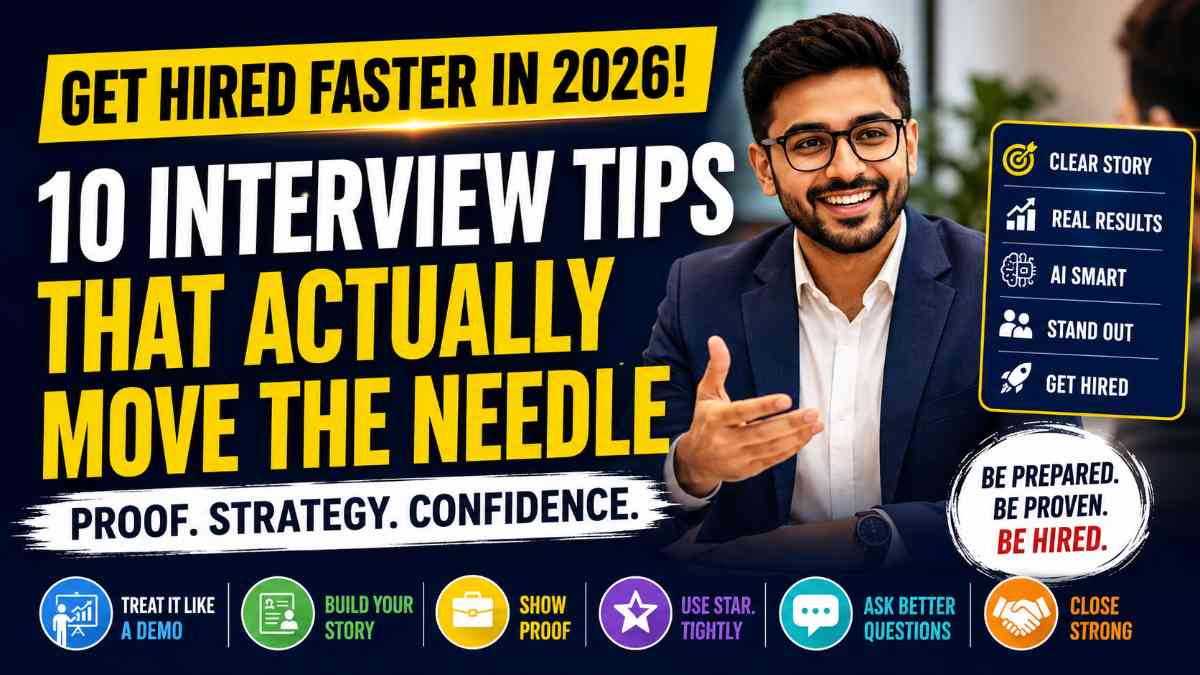
Here are 10 interview tips that actually move the needle this year.

1) Treat the interview like a product demo. Not a personality test.
Most candidates still show up thinking the goal is to be “likable.”
Sure. Be normal. Be pleasant.
But your real job is to demonstrate value quickly. Like a demo.
Before any interview, write down:
- What problem this role solves for the company.
- What “good” looks like after 30, 60, 90 days.
- The 3 to 5 skills they keep repeating in the job description.
Then build your answers to show those things, on purpose.
If the job is “own onboarding and reduce churn,” your stories should sound like: onboarding, retention, lifecycle, activation, metrics. Not “I’m passionate about customer success.”
Passion is fine. Proof closes.
2) Walk in with a 30 second pitch that doesn’t sound rehearsed
You need a crisp “Tell me about yourself” answer because it sets the tone. And because almost everyone still fumbles it.
Keep it simple:
- Present: what you do and who you help
- Past: one or two credibility highlights
- Future: why this role, why now
Example structure:
“I’m a data analyst focused on turning messy product data into decisions teams can actually use. Over the last three years I’ve worked on retention and pricing analysis at a SaaS company, and I led a dashboard rebuild that cut reporting time in half. I’m interviewing because I want to work closer to product strategy, and this role looks like it’s directly tied to growth decisions.”
That’s it. No life story. No wandering.
3) Build a small “proof portfolio” even if the role doesn’t ask for one
In 2026, hiring managers are tired. Not mean. Just tired.
Make it easy for them to trust you.
Bring a simple proof portfolio. A one page doc or a small Notion page is enough. Include:
- 2 to 3 mini case studies (Problem, Action, Result)
- A screenshot or artifact if possible (redacted is fine)
- Metrics. Even rough ones, as long as you explain them honestly
- A short “How I work” section (tools, rhythm, communication style)
If you’re early career, your case studies can be class projects, volunteer work, freelance, personal builds. But still do the structure. Still show results.
This one thing speeds up hiring decisions because you stop feeling abstract.
4) Use the STAR format. But tighten it so it doesn’t drag.
STAR still works. Situation, Task, Action, Result.
The mistake is people spend 70 percent on Situation. Like they’re writing a Netflix recap.
In an interview, keep it weighted like this:
- Situation and Task: 20 percent
- Action: 60 percent
- Result: 20 percent
And your Action should be specific. Tools, decisions, tradeoffs, what you did first, what you did when it broke. The real stuff.
Also. Always end with a result, even if it’s qualitative:
- “Reduced onboarding time from 12 days to 8.”
- “Cut support tickets by 18 percent.”
- “Aligned three stakeholders who disagreed and got the launch shipped.”
If you can’t measure it, say what changed. Speed, clarity, fewer errors, happier customers, better handoffs.
5) Expect AI era questions. And don’t pretend you “use AI for everything”
A lot of interviews now include some version of:
- “How do you use AI in your workflow?”
- “What do you automate?”
- “How do you verify accuracy?”
- “What do you do that AI can’t?”
The best answer is not “I prompt ChatGPT all day.”
A strong answer sounds grounded:
“I use AI to accelerate drafts and analysis, but I treat it like a junior assistant. For example, I’ll use it to summarize meeting notes into action items, generate a first pass at SQL queries, or create test cases. Then I verify everything. I double check sources, run the query logic myself, and I never paste sensitive customer data into public tools.”
That shows maturity. And it quietly signals you won’t create risk for the company.
6) Learn the job’s scorecard. Then answer like you’ve seen it before.
Many teams use structured interviews now, which means each interviewer is rating you on specific competencies. You can gain an advantage by guessing the scorecard from the job description and the company’s values page.
Common buckets include:
- Communication
- Ownership
- Execution
- Collaboration
- Problem solving
- Technical depth (role dependent)
When answering questions, label your thinking a bit to align with these competencies:
“Here’s how I approached it…” “The tradeoff was…” “What I did first was…” “I aligned stakeholders by…”
This strategy may sound simple, but it directly maps to how they score you. You’re basically handing them the rubric.
7) Stop saying “we” when they need to know what you did
Teams matter. Collaboration matters. But hiring managers still need to isolate your contribution.
So say “I” when you mean “I.”
Instead of:
“We launched a new feature and it went well.”
Say:
“I led the rollout plan, wrote the customer comms, and worked with engineering to set up a phased release. The result was a smoother launch and fewer support tickets than our last release.”
You can still mention the team. Just don’t disappear inside it.
8) Ask better questions than “What’s the culture like?”
You’re being evaluated when you ask questions, and also, you deserve real answers. Skip the vague stuff. Instead, ask questions that reveal the job’s reality:
- “What does success look like in the first 60 to 90 days?”
- “What are the biggest reasons this role is open?”
- “Where do people usually struggle in this position?”
- “What’s one project you want this person to own immediately?”
- “How do you make decisions when priorities conflict?”
- “What’s the feedback process like here, in practice?”
These questions do two things: They make you sound senior and help you avoid a job that looks good on LinkedIn but feels terrible on Tuesday.
9) Close the interview like you actually want the job
Most people end with “Thanks for your time.”
Which is polite. But it’s not a close.
Try this instead, near the end:
“Based on what we talked about, do you have any concerns about my fit for the role?”
This is uncomfortable. Good. It gives you a chance to fix misunderstandings in the moment.
Then finish with a direct close:
“I’m excited about this role because of X and Y. If you feel I’m a strong fit, I’d love to move to the next step. What are the next steps and timeline?”
You’re not being pushy. You’re being clear. Clarity speeds up hiring.
10) Send a follow-up that adds value, not fluff
Your follow-up email should be short and useful, ideally sent within 12 to 24 hours after your interview. A well-crafted follow-up email can reinforce your interest in the role and keep you top of mind for the interviewer.
Include:
- One specific thing you enjoyed from the conversation
- A quick recap of why you fit
- One relevant artifact if it helps (portfolio link, case study, short plan)
Example:
“Thanks again for today. I enjoyed talking about the onboarding dropoff problem and how the team is thinking about activation. Based on my experience reducing churn through onboarding experiments, I’m confident I can help you improve that funnel quickly. Sharing one short case study here in case it’s useful: [link].”
That’s it. No essays. No “circling back.”
A quick way to prep in 45 minutes (if you’re short on time)
If your interview is tomorrow and you’re panicking. Do this:
- Pick 5 stories that cover the main skills.
- For each story, write 3 bullets: Action, Result, Lesson.
- Prepare your 30 second pitch.
- Prepare 6 smart questions.
- Print or open your proof portfolio.
You don’t need to memorize. Just get clear.
Let’s wrap it up
Getting hired faster in 2026 is less about being the most impressive person in the room.
It’s about reducing uncertainty.
Show them what you’ve done. Show them how you think. Make it easy to imagine you doing the work, with their team, under their constraints. And then close like a professional.
If you do that, you’ll feel the difference almost immediately. Fewer “we’ll let you know.” More next steps. More momentum.
FAQs (Frequently Asked Questions)
How should I prepare my interview answers to demonstrate value effectively in 2026?
Treat your interview like a product demo, not a personality test. Beforehand, identify the problem the role solves, what success looks like in 30, 60, and 90 days, and the key skills mentioned in the job description. Then craft your answers to showcase those elements with specific proof of your ability to execute.
What is a good structure for answering ‘Tell me about yourself’ in an interview?
Keep your pitch crisp and natural by covering three points: Present what you do and who you help; Past one or two credibility highlights; Future why this role and why now. Avoid sharing your entire life story or sounding rehearsed.
Why should I bring a ‘proof portfolio’ to an interview, and what should it include?
Hiring managers are often overwhelmed and tired. A simple proof portfolio a one-page doc or Notion page with 2 to 3 mini case studies (Problem, Action, Result), relevant artifacts or screenshots (redacted if necessary), metrics, and a brief ‘How I work’ section helps build trust and makes you less abstract as a candidate.
How can I effectively use the STAR method without dragging my answers?
Use the STAR format but keep it concise: allocate about 20% of your answer to Situation and Task combined, 60% to Action with specific details like tools used and decisions made, and end with 20% on Result quantitative if possible or qualitative changes such as improved speed or clarity.
What kind of AI-related questions might I face in interviews, and how should I answer them?
Expect questions about how you use AI in your workflow, what you automate, how you verify accuracy, and tasks AI can’t do for you. Provide grounded answers that show maturity for example, using AI as an assistant for drafting or summarizing but always verifying outputs yourself without risking sensitive data exposure.
How can understanding a job’s scorecard improve my interview performance?
Many companies use structured interviews where candidates are rated on competencies like communication, ownership, execution, collaboration, problem solving, and technical depth. By studying the job description and company values to guess these competencies, you can tailor your answers explicitly to align with them and demonstrate you’ve anticipated their evaluation criteria.
